Friday, January 7, 2011

Maple Syrup Soy Sauce Salmon

This is one of my favorite ways to fix salmon-- it is easy and delicious. It is from Bob Blumer's Off the Eaten Path, a fun cookbook that is worth purchasing. It has great ideas and fun recipes like a salmon you wrap in foil and cook in the dishwasher and lemongrass shrimp you cook on a car engine. Plus it has this great salmon recipe.

Maple Syrup Soy Sauce Salmon

3 Parts Pure Maple Syrup
1 Part Soy Sauce
Salmon Fillets, Cut into 4-6 Ounce (113 g to 170 g) Pieces
Lots and Lots of Coarsely Ground Black Pepper

Combine 3 parts maple syrup and one part soy sauce in a plastic bag and add the salmon. Marinade over night up to 48 hours turning the salmon every so often (The recipe says marinade at least 4 hours-- but its best if you can marinade it overnight).

Marinating salmon


Once it is done marinating:

Preheat the oven to 500 F/260 C/Gas Mark 10.
Rub oil or spray with oil spray a sheet of aluminum foil or cookie sheet.
Place cracked pepper on a small plate and dredge one side of the salmon through the pepper.

A plate of cracked pepper
Place salmon pepper side up on the foil or cookie sheet.


Bake on the top rack of the oven for 7 minutes.


That's all of there is to it.

Katie's salmon with less pepper

Wednesday, January 5, 2011

Chocolate Chip Cookies Regular Oven vs Convection

Convection ovens are wonderful for roasting meat-- but how about baking cookies?

My family was happy to be the taste testers. I used the chocolate chip cookie recipe on the back of the Nestle chocolate chip bag (available here: http://www.verybestbaking.com/recipes/18476/Original-NESTL%C3%89-TOLL-HOUSE-Chocolate-Chip-Cookies/detail.aspx).  I used a cookie sheet (the kind without sides- a jelly roll pan has sides) and let the cookie sheet cool between batches.


I cooked the cookies in the regular oven at 375 F/ 190 C for 9 minutes. In the convection oven I cooked them at 350 F/175 C for 7 minutes.

The Results

The convection oven cookies were sightly "puffer" or lighter. The regular oven cookies were "denser" and "chewier". Katie and Steven thought that there wasn't enough of a difference to pick one over another-- they liked both.

I liked the convection oven better for two reasons. The first reason- I cooked them for 2 minutes less per batch. The second reason (and most important one)- multiple trays of cookies can be cooked at once because of the circulating air (which keeps the oven at a consistent temperature throughout the oven).

Monday, January 3, 2011

New Year's Day Lucky Foods

Kale Salad- Lucky and Healthy
Different cultures have different traditions of what to eat on New Years for a lucky year. I grew up eating pork, sauerkraut, and mashed potatoes (traditional German food). I can't imagine a New Years Day without  the dinner from my childhood. As it turns out pork and cooked "greens" tend to be standard lucky foods. The type of green and how it is cooked varies by country. Here is a summary of my favorite lucky foods.

The Spanish eat 12 grapes at midnight. One grape for each stroke of the clock (and each month of the year), a practice which began in 1909 with a grape surplus in the Alicante region of Spain. The idea stuck and actually spread to Portugal (except they have 13 grapes) and former Spanish colonies.The rub to this tradition is if you get a sour grape- the month it represent you will have a bad month. For instance, if the 10th grape you eat is sour, then October will be a rough month. One of these years, I am going to try this one.

Greens are considered lucky because they look like folded money and the more you eat, the larger your fortune is supposed to be in the year ahead. In the south, collard greens are the greens of choice. In Denmark it is kale cooked with cinnamon and sugar and in Germany sauerkraut.

Legumes (beans, peas, and lentils) look like coins so they are supposed to be lucky as well. In the South of the United States- "Hoppin John" (black eyed peas) are a standard New Year food. In Italy
cotechino con lenticchie (sausages and green lentils) are eaten and in Brazil lentil soup or lentils and rice is traditionally eaten.

Pork is believed to be lucky because of the way pigs root for food, they keep their feet planted and push their snouts forward. This signifies progress and prosperity. Others believe the high fat content in pork will ensure a prosperous year.

Fish are thought to bring good fortune because they swim forward; others believe they symbolize abundance because they swim in schools. In Japan, fish and other seafood are also consumed because they symbolize fertility (the herring roe), long-life (shrimp) and sardines (good harvest).

In many Asian countries noodles are eaten at the New Year to represent a long life. There is one catch- you cannot cut or break the noodle before it is in your mouth. 

Cakes (especially round cakes because they represent coming full circle) are also eaten in several countries- in Italy they eat panetonne, in Greece- vassilopita (a cake with a  hidden good-luck coin), and in Mexico- rosca de reyes cake.

The couple of foods to avoid are lobster (they swim backwards and you could lead to setbacks), chicken (they scratch backwards which could result in regret), and winged fowl (your good luck could fly away).

This year we had a small dinner party and asked everyone to bring a "lucky" food. The results were delicious and hopefully lucky. Here is what we had:
Cheese coins

Mexican Seven Layer Dip (lucky food: beans)
Pepper Cheese Coins (lucky food: coins)
Kale Salad with Peanut Dressing  (Lucky food: greens)
Jambalaya (Lucky food: shrimp)
Pork Ribs (Lucky food: pork)
Bacon Wrapped Pork with Red Currant and Onion Relish (lucky food: double pork!)
Rosemary and Garlic Rubbed Pork with Rosemary Chimichurri (lucky food: pork)
Mashed Potatoes and Gravy
Sauerkraut (lucky food: greens)
Homemade Marshmallows
Duche de Leche Cheesecake Bars
Peppermint Bark

Friday, December 24, 2010

Feast of the Seven Fishes


Clay pot clam bake
This Christmas Eve we decided to attempt the feast of the seven fishes (festa dei sette pesci), a traditional Sicilian meal. It is based on the Catholic tradition of the La Vigilia di Natale, the Vigil of the Holy Night, where some Catholics abstain from eating meat. 

I think the seven fishes correlates to the seven Sacraments in the Catholic Church.[i] However, seven is an important number in other contexts--- the seven virtues[ii]; the seven hills of Rome; seven gifts of the Holy Spirit[iii]; and the seven utterance on the cross. Some Italian-American families have 9, 12, or 13 different seafood/fishes.

The meal consists of whatever is fresh where you live and your means. The "traditional" items I came across were:  eel, smelts, salted cod (baccalà), linguine with clams (Linguine con le Vongole-- one of my favorite all time dishes), calamari, and anchovies.

I am quite excited about the meal. I am also slightly anxious-- it is a lot of work and several of the recipes I have not made before. Thankfully, I am making three of my favorites dishes (Caesar salad, clam bake, and cheesecake).

Here is what we have planned:
  • Cheese antipasti (to snack on all day long); 
  • Caesar salad (with anchovies) (recipe below)
  • Clam bake with clams, scallops, and shrimp cooked in a clay pot (recipe below- adapted from The Clay Pot Cookbook by Georgia MacLeod Sales and Grover Sales); 
  • Salt cod in tomato caper sauce[iv];
  •  Lobster tail (see preparation below); 
  • Crab ravioli in a lemon butter caper sauce[v];  
  •  Italian cheese cake; and 
  •  to top it all off we plan to have a mint (it's wafer thin....).
Caesar Salad
Steven usually makes the Caesar salad which frees me up to stress over last minute details. Here is the recipe---


Mash together one tablespoon of anchovy paste, 3 cloves of garlic (minced), and two teaspoons of champagne mustard. Then add the juice of one third of a lemon and salt and pepper and mix; slowly add two tablespoons of olive oil. Toss cut up romaine lettuce with the dressing-- adjust salt and pepper and then add shredded Parmesan cheese to taste. Prior to serving add croutons.

Caesar salad
Clam Bake
The first crisis was no clams. I went to Whole Foods yesterday to check that they would have clams today. I was assured that they would. This morning-- bright and early--- I went to Whole Foods to buy the seafood and no clams. Whole Foods did some wonderful service recovery and gave me mussels as a substitute (for free). So I guess this is a mussels bake??? 


The mussel bake is really easy- first soak your clay pot for 20 minutes and then put the following into the pot (in order)---


Clay pot clam bake
Sliced onion (one onion thinly sliced); mussels (8 oz/227 g), shrimp (1 lb/454 g shells on), scallops (8 oz/ 227 g), squeeze the juice of one lemon over the seafood and then either zest the lemon and add the zest or slice the lemon and add it, 1/4 cup (125 ml) white wine, 5 cloves of garlic (whole), fresh parsley, fresh thyme, and red pepper (we used a hot lemon pepper instead of red pepper), salt, and pepper to taste. Place in a cold oven and set oven to 450 F/ 232 C. Cook for 40 minutes. Serve with bread.  Note-- sometimes I add a piece of study fish to the mixture, clams, clam juice, lobster and/or crab. Also I add whatever fresh herbs I have-- oregano, basil, thyme, ect.... Also don't forget to rinse and dry your seafood before you put it in the pot.
Mussel bake

Lobster Tail
We had frozen lobster tails and thawed them in the refrigerator overnight. We cut the shell down the middle and added butter, garlic, parsley, lemon juice, salt, and pepper. We baked the lobster tails in a 350 F/ 177C/ Gas Mark 4 oven for 8 to 10 minutes.
Baking lobster tails
Crab Ravioli


The stuffed ravioli- much easier using wonton wrappers
I cheated with the crab ravioli- not only did I make them in the morning and put them in the refrigerator-- I also used fresh wonton wrappers. It wasn't as good as fresh pasta-- but it was quick and easy (I was really worried about the timing). I  also rinsed and drained the capers (to get rid of the brine taste). I thought the lemon butter caper sauce was wonderful and complimented the crab.
Finished raviolis


 Baccalà

Baccalà
I made the tomato sauce in the morning so it would be ready and I could just heat it up and cook the fish when the dinner was almost ready. We grow hot pepper each summer and dry them-- so we used a combination of hot pepper for the sauce. I think it makes a difference. I really liked the sauce-- the combination of slightly sweet onions with the capers and hot pepper is addictive and we will be making it again.
 
Dried peppers ready to be ground
Freshly ground and ready to add to the sauce!


[i] They are: Baptism, Holy Communion, Confirmation, Reconciliation, Anointing of the Sick, Holy Orders, and Marriage.
[ii] They are: faith, hope, charity, temperance, prudence, fortitude and justice.
[iii] They are: counsel, fortitude, knowledge, understanding, piety, wisdom, and fear of the Lord.

Sunday, December 19, 2010

Grilled Steaks Covered in Salt and Blue Cheese and Butter


The finished steaks - cheesy and buttery.
Steven and I (well mainly Steven) have developed this steak recipe over the last decade. Steven does most of the work and it is a bit of work. It is so worth it. This is our special occasion steak; it is the full fat version that other steaks are jealous of (we make sure we have biked earlier in the day so we don't feel as guilty eating it).

Preparation

Let the steaks come to room temperature
Combine equal parts softened butter and blue cheese
Butter cheese mixture


At this point light the coals for the grill.

The coals are ready.
A chimney makes lighting coals easier.
Rub Kosher salt (to taste) on one side of the steak (you will grill this side first).

Preheat oven to 500 F/ 260 C/ Gas Mark 10.
Cut butter into tablespoon pieces- one for each person eating

Create a "heat proof" place mat for each person eating-- the plates are coming out of the oven and will be HOT


Cooking (Scratch that - Grilling)
Grill the salt covered side first; when you flip the steak cover the cooked side with the cheese butter mixture.
Meanwhile place plates in oven to heat


Once the steaks are cooked to the desired temperature (you may want to under cook them slightly) take the plates out of the oven and put one piece of butter on each plate (it will sizzle) -- put the steaks on the heated plates (on top of the butter) and carefully enjoy.
Hot steak and hot plate with the butter melting on the plate


Blue cheese covered steaks
We served ours with crostini (toasted bread smothered in olive oil and garlic), a simple side salad, and Seghesio Zin. 
The bottom line: Will we have this again? Yes, we will as often as I can talk Steven into making it. 

Fleur de Sel Caramels


The finished caramels: one with salt and one without.
Candy making and baking are basically chemistry. They require following recipes and measuring ingredients (which is sometimes difficult for me - I like to improvise). Having written that, I have always been comfortable with baking and I will improvise with baking. But candy making not so much. Maybe it is the hot boiling liquids which could result in some nasty burns. Maybe it is the amount of time one spends stirring. But the results are so good that I am willing to give candy making a try. I have decided to start my foray into candy making with caramels. Full disclosure- we have made caramels before (we are crazy about caramels) so we are taking baby steps. This caramel recipe is spectacular--it makes melt in your mouth caramels.  It uses only a couple of ingredients-- so quality counts (I have notes below on two of the ingredients).

The different crystal sizes- Kosher, fleur de sel, and table salt.
Fleur de Sel

Fleur de Sel means "flower of salt". It is hand harvested sea salt, collected by scraping the top layer of salt before it sinks to the bottom of large salt pans. It is expensive (I only brought about a tablespoon for this recipe-- Whole Foods sells it by the ounce). (I did not buy the really expensive salt- hand harvested off of the coast of Brittany). It is a "wetter" salt and has a crystal size that is much larger than table salt but smaller than Kosher salt. Good substitutes would be Flor de sal, Maldon Sea Salt Flakes, and Cyprus Sea Salt Flakes. In a pinch, I think you could use Kosher salt. For an interesting article on salt tasting please see: http://www.slate.com/id/2117243/

Vanilla

Years ago I was introduced to Mexican vanilla and fell in love. I was careful to use the good vanilla only for special recipes. Then I realized that the good vanilla was one of the ways I made the recipe special. So I did some research and food out that making your own vanilla was really easy and the results were great. Now we use the good vanilla for every recipe. To make your own vanilla- buy a bottle of vodka and add two to three vanilla beans cut down the middle to the vodka. Every week shake the bottle and in two months you have a big bottle of great vanilla. I keep the beans in the vodka and it improves over time. That is all there is to it. I use the same amount of homemade vanilla as store bought vanilla in my cooking.

Caramels

2 Cups (500 ml) Heavy Whipping Cream10 Tbsp of Unsalted Butter, cut into pieces
2 Tsp Fleur de Sel
3 Cups (675 g) of Granulated Sugar
1/2 Cup (125 ml) of Light Corn Syrup
1/2 Cup (125 ml) of Water
1 Tsp of Vanilla

Line 9 by 13 (23 cm by 33 cm) baking pan with parchment and lightly oil the paper (I like to lightly oil both sides so the parchment will stick to the pan as well). I also put all of the ingredients in the sauce pans (except for the vanilla so they are ready to go).


Everything is prepped and ready to go.
 In a small sauce pan bring the cream, butter and salt to a boil and set aside.

I cut the butter into tablespoon-size pieces.
The sugar mixture starts out clear
In a large saucepan bring the sugar, corn syrup and water to a boil. Stir until sugar is dissolved then boil while swirling (not stirring) until the mixture is a light caramel color. (It feels like this step takes forever).

After the sugar mixture reaches a caramel color, add the cream
CAREFULLY stir in the cream mixture (it will boil violently). Next stir in the vanilla.  Simmer the mixture, stirring frequently until the camel registers 248 F/ 120 C on a candy thermometer. (High attitude: for every 1,000 feet/300 meters above sea level, subtract 2 F/1 C from the desired temperature).
The reaction after adding the cream mixture- Careful- it gives off a lot of steam
Boiling mixture


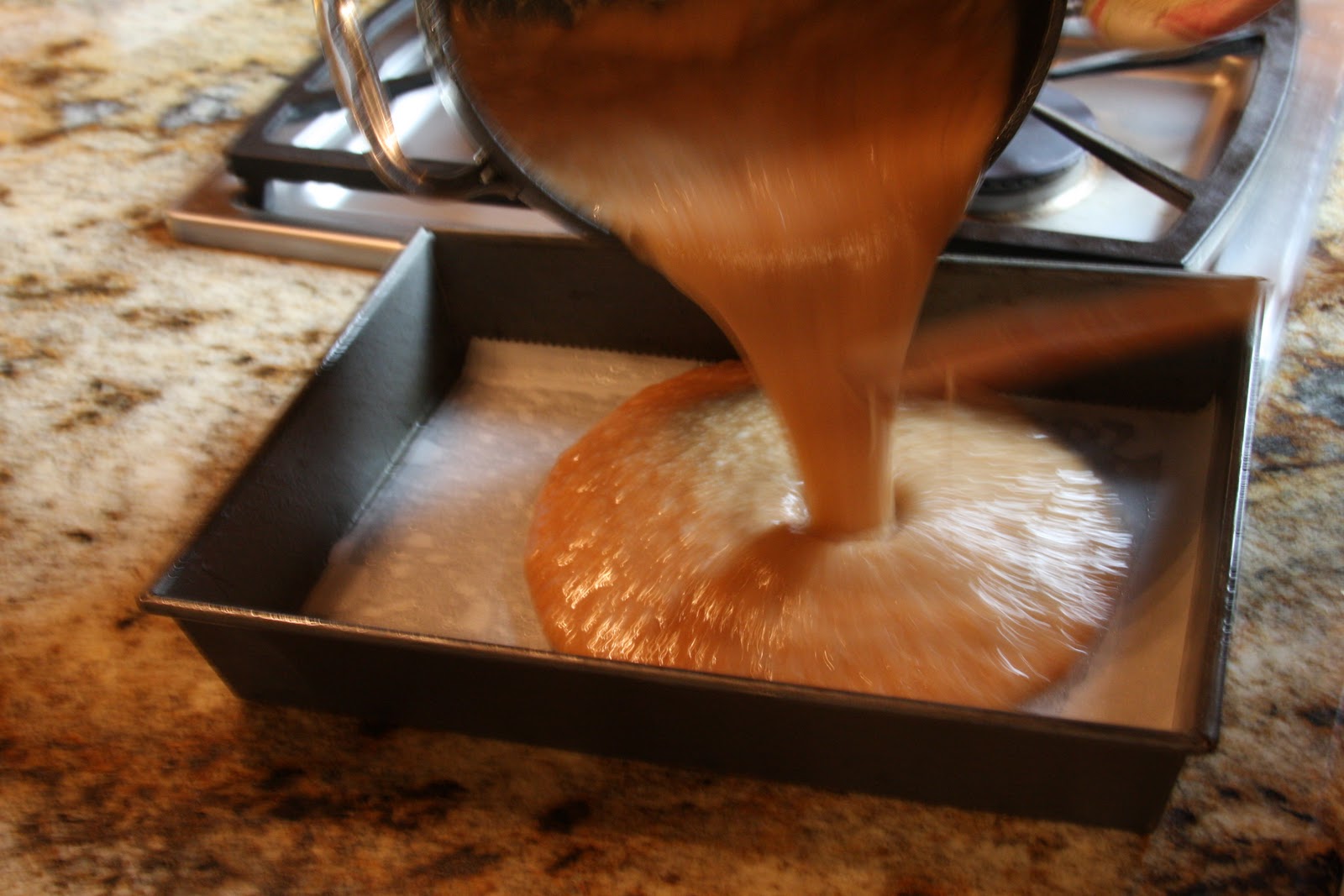
Carefully pour the caramel mixture into the prepared pan and cool until the caramels come to room temperature. Turn the caramels over onto wax paper and remove the parchment from the back of the caramels. Cut the caramels into bite size pieces and wrap in wax paper. We sprinkled 1/3 with fleur de sel, 1/3 we left plain, and 1/3 we dipped in chocolate. 
The caramels being poured into the prepared pan


More full disclosure- I reviewed and modified the following recipes to end up with the recipe above-- Ina Garten's recipe: http://www.foodnetwork.com/recipes/ina-garten/fleur-de-sel-caramels-recipe/index.html and Epicurious's recipe: http://www.epicurious.com/recipes/food/views/Fleur-de-Sel-Caramels-230778

The bottom line: Will we make these again? Yes, yes we will. Based on how many we eat, we probably shouldn't. They are so so good.